The Art of Getting to Good Enough
Michael Kitces is one of the most influential voices in financial planning; if you follow the industry at all, you know him. You might also know that he wears a cobalt blue shirt more or less every day. It started as a running joke when a colleague teased him for wearing the shirt to two conferences in a row, and rather than shrink from it, he leaned in. It became his brand color. But it also took one more daily decision off his plate.
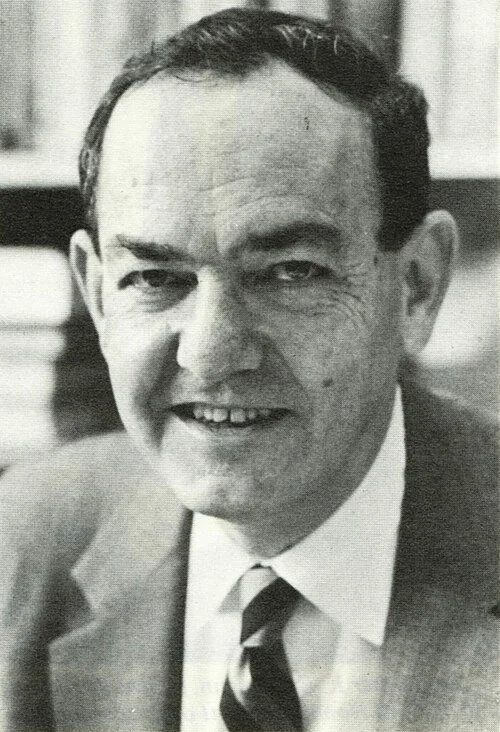
My wife pointed out that a man can wear the same white Oxford and jacket every day without anyone noticing. Unfortunately, there’s no equivalent for a woman. (photo of Herbert Simon)
A recent essay in The New York Times by David Epstein highlights a Nobel-winning psychologist, Herbert Simon, who believed that such simplifications are actually the key to happiness in a world of endless choice and the pressure to always optimize. A pioneer of artificial intelligence as well as an economist, Simon ate the same breakfast for decades, owned one style of most things, and lived in the same house for 46 years. He did it on purpose. By clearing away those small decisions, he saved his attention for the work and relationships he cared about most.
Maximizing vs. Satisficing
Simon gave us a word for this: satisficing, a blend of "satisfy" and "suffice." His insight was that most real decisions are simply too big to optimize. We rarely have the time, information, or mental bandwidth to line up every option and rank them. Satisficers scan a workable handful, commit to one that's good enough, and get on with things. While I have no interest in eating the same breakfast every day, I can relate to the decision fatigue of modern life in matters both large and small. We are bombarded with so many options and endless opportunities to compare our lives to those of our neighbors and strangers.
The opposite instinct is maximizing: the search for the very best option, whatever it takes. As Epstein summarizes the research that followed Simon's work, maximizers tend to be less satisfied with their decisions and, often, with their lives; they are more prone to regret and more likely to compare themselves endlessly to others. It isn't that satisficers have low standards. As he puts it, their standard is "good enough for me" rather than "the best out there," and that’s what lets them feel settled with a choice rather than haunted by the ones they passed up.
A word before this starts to sound like judgment. The impulse to analyze is not a defect to be corrected; it is close to the center of what makes us human. We named ourselves Homo sapiens, the wise and discerning animal, and weighing our options is among the oldest and most useful things we do. So getting stuck between choices is rarely a character flaw or a failure of discipline. More often, a good instinct has simply run past the point where it helps and is usually undergirded with some real anxiety. What eases that is compassion and a little perspective, not an exasperated "just decide already."
This is also not a recommendation to just roll the dice. Big decisions deserve real thought and, often, real expertise. The skill is not simply deciding faster; it is knowing when you have done enough analysis to decide well, then embracing the inherent uncertainties and adapting as life unfolds.
Accounting for Search Costs
It also helps to remember that searching itself has a cost. This is one reason I love Trader Joe's and Wirecutter. Both do the comparing for me. Trader Joe's stocks a few good options instead of forty; Wirecutter tells me which dishwasher to buy so I don't have to wade through 300 reviews. If Dante were writing today, one of the outer circles of the modern inferno might be an eternity of scrolling online reviews, forever sure something slightly better is on the next page. I have found that when I outsource the search, I'm rarely disappointed. Even when a particular decision turns out to be less than optimal in hindsight, I’m far less emotionally invested in it and therefore better able to roll with the disappointment or change course.
In my work, I watch this play out with much bigger decisions: which investment strategy to follow, which house to buy, whether to leave your job, how to plan for the possibility of long-term care, when to retire. Of course, all of these deserve careful thought; that is the whole point of planning. The trouble starts when the search for the perfect answer makes you miss out on so much else, including that elusive perfect option.
I am not above any of this. I have spent a beautiful afternoon inside, fine-tuning a financial model, while the day slipped by outside. I have a slightly unhealthy Zillow habit, forever hunting for the perfect farmhouse where I might someday live out a pastoral dream. I have often engaged in what Freud called the narcissism of small differences, fixating on two options that are, if I am honest, nearly identical.
Epstein quoted the psychologist Mihaly Csikszentmihalyi, who pointed out that when you commit to a choice, regardless of the shinier options that might come along later, "a great deal of energy gets freed up for living, instead of being spent on wondering about how to live." I see that release in people all the time. It rarely comes from proving a particular plan is mathematically optimal or that we’ve accounted for every contingency. It comes from choosing a course that is good enough, and then getting to go live.
Help with Getting to Good Enough
It’s important to remember that none of this means going it alone. Part of what a planner does is what Wirecutter does for a dishwasher: narrow the field, frame the decision, and surface the few hinge points that actually change the answer. Good advice lowers the cost of deciding; it doesn't hand you another twenty options to weigh.
On the planning side, I love the details; mapping out a Roth conversion plan is genuinely how I like to spend a Tuesday. I know that's a little strange. But in my own life I don't model everything out to the nth degree. When we recently committed to a major investment in my wife's ophthalmology practice, we brought in consultants to analyze and guide the process, and then we largely trusted their recommendations. We could have studied many more angles, but we received a good, well-framed analysis, and we decided that was good enough.
So set your good-enough standard before you start comparing. Decide in advance what would make an option a yes. And when something clears that bar, let it be enough. Save your energy for the parts of life that are actually worth your full attention.
This piece was prompted by David Epstein's essay, "The Nobel-Winning Psychologist Who Believed He Found the Secret to Happiness" (The New York Times, May 12, 2026).